
IKE Network
IKE Network 2
-
Home
- IKE Network
The IKE Checkpoint Pipeline
A checkpoint turns an entire workspace — many independently versioned repositories — into one reproducible, tagged snapshot, and a continuous-integration chain turns that snapshot into signed installers and a chat announcement. One command, ws:checkpoint-publish, starts it; everything after the git tag is automated. The worked example throughout this page is the Komet workspace (ike-komet-wsr, a dozen repositories), whose checkpoint chain is the pipeline’s first and largest deployment — the ws: goals themselves are workspace-agnostic.
This page explains the machinery end to end: the goal that cuts the checkpoint, the build that produces the .pkg and .msi installers, and the step that posts the result to Zulip. It is written for two readers — an operator who needs to cut a checkpoint, and an engineer who needs to understand or change how the pipeline works. Each stage closes with a Where the machinery lives note pointing into the source.
The three stages
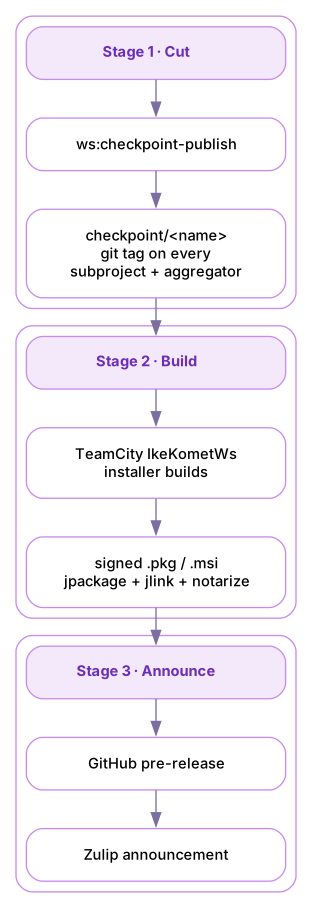
| Stage | What happens | Where it runs |
|---|---|---|
| 1 · Cut | ws:checkpoint-publish aligns versions, verifies the reactor builds, tags every subproject and the workspace aggregator at their current HEAD, writes a checkpoint manifest, and pushes. |
Operator’s machine, via the ws plugin (ike-platform). |
| 2 · Build | The pushed checkpoint/* tag triggers TeamCity, which builds native installers with JReleaser + jpackage, signs them, and notarizes the macOS package. |
CI (TeamCity project IkeKometWs). |
| 3 · Announce | The publish build creates a GitHub pre-release from both installers and posts an announcement, with a generated changelog, to Zulip. | CI, via the notify-zulip.sh step (ike-ci). |
Stage 1 — Cut the checkpoint
A checkpoint is a coordinated tag across the whole working set. Because Komet is assembled from many repositories, a single repo’s commit hash says nothing about whether the assembly builds. The checkpoint records the exact SHA, branch, and version of every member so the assembly is reproducible from one name.
The goal ships as a draft / publish pair — the same convention used throughout the ws plugin — so you can preview before you mutate:
-
ws:checkpoint-draft - Read-only preview. Runs the preflight checks and prints the tag it would create and the SHAs it would capture, writing nothing.
-
ws:checkpoint-publish -
The mutation. It extends the draft behavior with four safeguards, in order:
- Require a clean working set — every subproject tree must match its committed
HEAD, so the tag is reproducible. - Auto-align — runs
ws:align-publishto apply inter-subproject version alignment, committing any changes as aworkspace: pre-checkpoint alignmentcommit. - Verify the reactor — runs
clean verify -DskipTestsacross the whole reactor and refuses to cut a checkpoint that does not build. (Skippable with-Dws.checkpoint.skipVerify=truewhen you have already built.) - Tag and push — in topological order, tags each subproject
checkpoint/<name>, writes the manifest tocheckpoints/checkpoint-<name>.yaml, updatesworkspace.yamlwith the captured SHAs, tags the aggregator, and pushes tags and branch toorigin.
- Require a clean working set — every subproject tree must match its committed
The checkpoint name defaults to <branch>-<yyyyMMdd>-<HHmmss> (UTC), e.g. main-20260622-030143. That timestamped name becomes the tag, the manifest filename, and the logical branch CI builds against.
Operator quickstart — from the workspace root (ike-komet-wsr), always through ws goals, never raw git:
# 1. Commit any work-in-progress (needs a Refs:/Fixes: issue trailer)
mvn ws:commit-publish -Dpush=false -Dmessage="..."

# 2. Push the commits
mvn ws:push

# 3. Preview the checkpoint
mvn ws:checkpoint-draft

# 4. Cut and push it (tag + manifest + push are atomic)
mvn ws:checkpoint-publish
checkpoint-publish tags and pushes in one step — there is no separate push toggle. Cutting from a freshly scaffolded clone needs care: the scaffold step leaves regenerable noise (wrapper files, CLAUDE.md edits) in each subproject tree, and the clean-tree preflight will refuse until that is stashed.
Module ike-workspace-maven-plugin in ike-platform, package network.ike.plugin.ws:
WsCheckpointDraftMojo—@Mojo(name = "checkpoint-draft"); the preflight, name derivation, and per-subproject tagging loop.WsCheckpointPublishMojo—@Mojo(name = "checkpoint-publish"); extends the draft with the clean-state, auto-align, reactor-verify, and push safeguards.CheckpointSupport— the per-subproject tag-and-push engine, and the draft preview.SubprojectSnapshot— the immutable(name, sha, branch, version, modified)record written into the checkpoint YAML.
Repository: IKE-Network/ike-platform[1].
Stage 2 — Build the installers
The pushed checkpoint/ tag is the trigger. TeamCity project *IkeKometWs discovers the tag and runs two installer builds — macOS and Windows — that each rebuild the tagged assembly into a native, signed package. Installers are date-versioned (e.g. 26.625.118-osx-aarch64), so no workspace SNAPSHOT qualifier ever reaches the shipped file.
The installer itself is assembled by JReleaser driving the JDK’s jlink and jpackage:
- jlink produces a trimmed Java runtime image containing only the modules Komet needs, plus JVM options and resources.
- jpackage wraps that image into a platform-native installer —
.pkgon macOS,.msion Windows, with.rpm/.dmgvariants available.
On macOS the package must additionally pass Apple’s signing and notarization gauntlet, which is where the ike plugin’s installer goals come in. They run as Maven phases around the jpackage step:
| Goal | What it does |
|---|---|
ike:jpackage-props |
Computes the ~19 derived properties JReleaser needs — build timestamp, platform triple, and the date-based app version (with the Windows minor ≤ 255 constraint handled separately). |
ike:codesign-natives |
Signs every native library (.dylib/.jnilib), including those nested inside JARs (JNA, RocksDB), with the hardened-runtime entitlements Apple Silicon requires — without them the JVM crashes on launch. |
ike:codesign-pkg |
Re-signs the .app bundle inside the .pkg with entitlements (a workaround for older JDKs; auto-skips on JDK 25.0.2+ where jpackage signs correctly). |
ike:notarize |
Submits the package to Apple’s notary service, waits for acceptance, staples the ticket, and verifies it with spctl. |
The same komet-desktop build runs locally in fast-dev mode by default — it produces only the jlink runtime image and skips installer, signing, and notarization. The full installer path activates with IKE_RELEASE=1 (the signed-installer profile), which is what CI sets.
A recurring non-code failure: notarization can return Apple HTTP 403 — "a required agreement is missing or has expired." That is the Apple Developer account’s license agreement needing re-acceptance, not a build problem.
JReleaser config in komet-desktop (inside the ike-komet-wsr workspace):
src/main/jreleaser/jreleaser.yml— thejpackageassembler (.pkg/.msi/.rpm, signing, icons, resources).src/main/jreleaser/jreleaser-jlink.yml— thejlinkassemblers (runtime images, JVM options, file sets).src/main/resources/installer/— platform installer assets (entitlements plist, backgrounds, Windows icon).
Installer/signing goals in ike-maven-plugin (ike-tooling), package network.ike.plugin: JpackagePropsMojo, CodesignNativesMojo, CodesignPkgMojo, NotarizeMojo.
CI build configurations: TeamCity project IkeKometWs (InstallerMacOS, InstallerWindows).
Stage 3 — Announce to Zulip
When both installer builds are green, the publish build (IkeKometWs · Publish to GitHub) creates a GitHub pre-release and attaches both installers, then posts an announcement to Zulip so the team — and watchers — learn a fresh build is available.
The announcement is produced by notify-zulip.sh, the shared notifier used across IKE release pipelines. It:
- resolves the target stream and finds-or-creates a topic, so a multi-step release threads under a single conversation rather than spamming one message per build;
- posts terse progress as the chain advances, then a rich summary — a generated "what changed" changelog plus links to the release — on the final build;
- is best-effort: a notification failure is logged but never fails the release.
The changelog body comes from the ike plugin’s release-notes machinery (ike:release-changelog / ReleaseNotesSupport), which derives entries from commit trailers and the GitHub milestone, so the human-readable "what changed" is generated, not hand-written.
notify-zulip.sh— the notifier, embedded as the final build step of each release/publish configuration in ike-ci (.teamcity/).IkeReleaseChangelogMojo(ike:release-changelog) andReleaseNotesSupportin ike-tooling — generate the changelog the notification and the GitHub release share.
Stream, bot identity, and API key are TeamCity project parameters sourced from 1Password; no secret is committed. The operator-facing release and CI topology is documented in release-operations.adoc in ike-infrastructure.
Source repositories
| Repository | What it contributes |
|---|---|
| ike-platform[1] | The ws:checkpoint-draft / ws:checkpoint-publish goals (Stage 1). |
| ike-tooling[2] | The ike:* installer, signing, notarization, and changelog goals (Stages 2–3). |
| ike-komet-wsr[3] | The Komet workspace and `komet-desktop’s JReleaser/installer config (Stage 2). |
| ike-ci[4] | The TeamCity configuration and notify-zulip.sh (Stages 2–3). |