---
date_published: 2026-05-17
date_modified: 2026-05-17
canonical_url: https://ike.network/ike-tooling/ike-maven-plugin/index.html
---
# IKE Maven Plugin
The `ike-maven-plugin` provides the `ike:*` goal prefix — single-repo release orchestration, the release cascade, site deploy + publishing, scaffolding, native packaging utilities, and BOM generation. The AsciiDoc doc-rendering pipeline moved to `ike-doc-maven-plugin` (`idoc:`) in `IKE-Network/ike-issues#437`.
| Coordinate | Value |
| --- | --- |
| Group ID | `network.ike.tooling` |
| Artifact ID | `ike-maven-plugin` |
| Goal prefix | `ike:` |
| Packaging | `maven-plugin` |
| Java version | 25 |
For workspace-spanning goals (`ws:*` prefix), see the [ws plugin](https://ike.network/ike-platform/ike-workspace-maven-plugin/)[1] in `ike-platform`. The two plugins are deliberately separate — `ike:*` is single-repo, `ws:*` fans out across a workspace’s checked-out subprojects.
## [#plugin-shape](#plugin-shape)Plugin shape
This is a **regular Maven plugin** — no `true`, no custom `` type registered via `META-INF/plexus/components.xml`, no participation in the build extension realm. Goals look up at execution time, the plugin’s `` interpolates from `${ike-tooling.version}` like any other managed plugin, and consumers inherit the version through ordinary `` indirection.
This was not always the case. Earlier revisions registered the `ike-doc` custom type here (the stale `components.xml` removed per `IKE-Network/ike-issues#320`), which forced this plugin to be loaded as a build extension and consequently forced its `` to be a literal string everywhere it was declared. That constraint was retired alongside the migration to a classifier-canonical doc shape — see the [ike-tooling reactor home](#https-ike-network-ike-tooling) for the full design rationale, or `IKE-Network/ike-issues#321` for the umbrella tracking issue.
What this means for plugin consumers: nothing changes about how you **invoke** `ike:*` goals. What changed is that the plugin no longer forces literal-version pins in your POM, and no longer contributes `ike-doc` to your reactor. Doc modules use `pom` (or `jar` for hybrids) plus an `adoc` classifier attachment; the activation is path-conditional on `src/docs/asciidoc/` existence in `ike-parent’s `doc-pipeline` profile.
## [#goal-naming-convention](#goal-naming-convention)Goal naming convention
Most state-mutating goals come in a draft / publish pair:
```
mvn ike:release-draft # report what would happen, write nothing
mvn ike:release-publish # apply the changes
```
The bare goal name (e.g. `ike:release`) is wired to the draft variant. This is the same convention used by `ws:*` — every mutation is two-phase with a real chance to audit the draft before committing.
Read-only goals (e.g. `ike:help`, `ike:env`) have no draft/publish split — they are always safe.
## [#quick-start--intellij-idea](#quick-start--intellij-idea)Quick start — IntelliJ IDEA
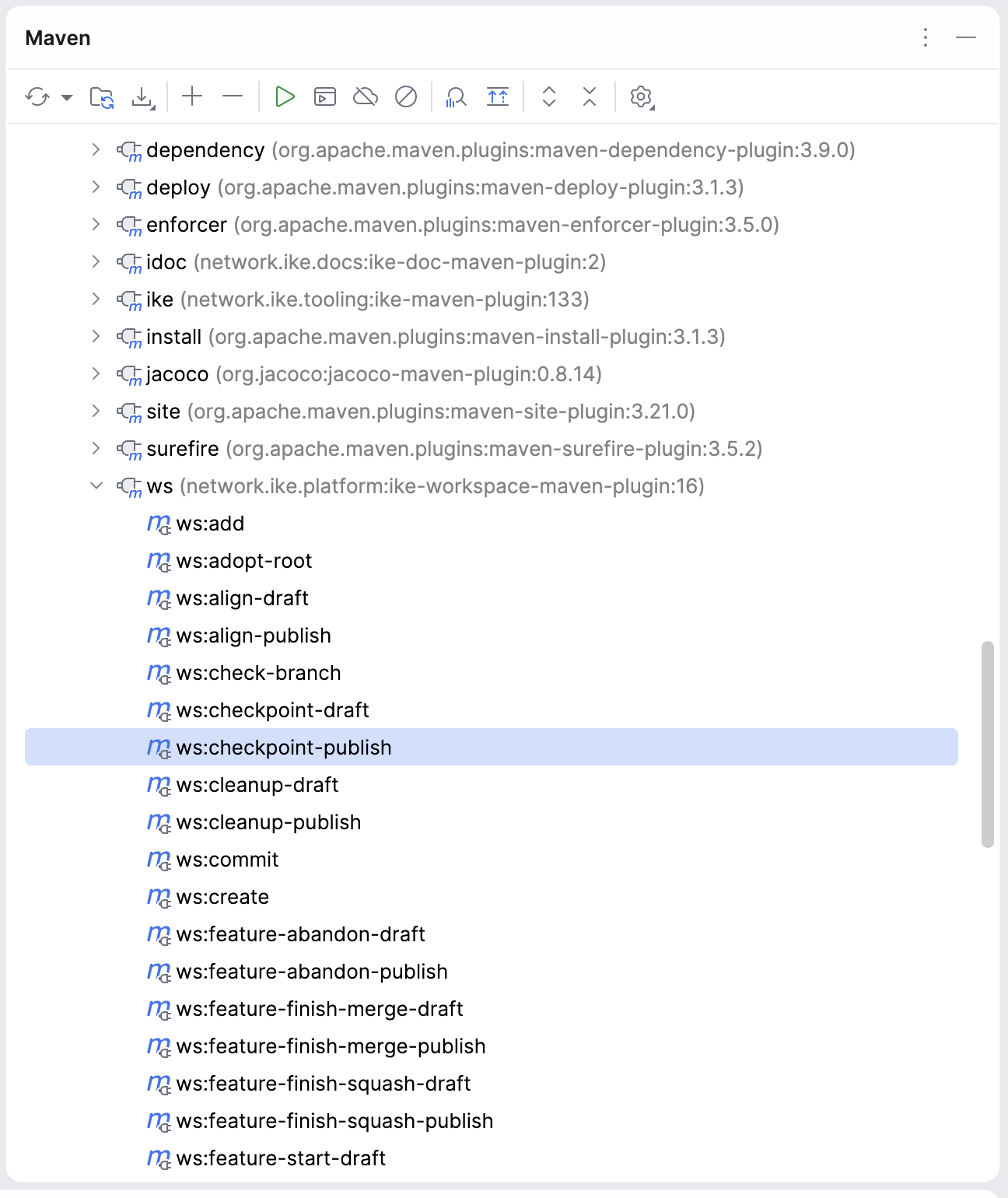
Open the project in IntelliJ. The Maven tool window (right sidebar, **View → Tool Windows → Maven** if hidden) auto-discovers the `ike:*` goals from this plugin’s `` declaration in `ike-parent`. Both `ike` and `ws` (the workspace plugin) appear as top-level entries:
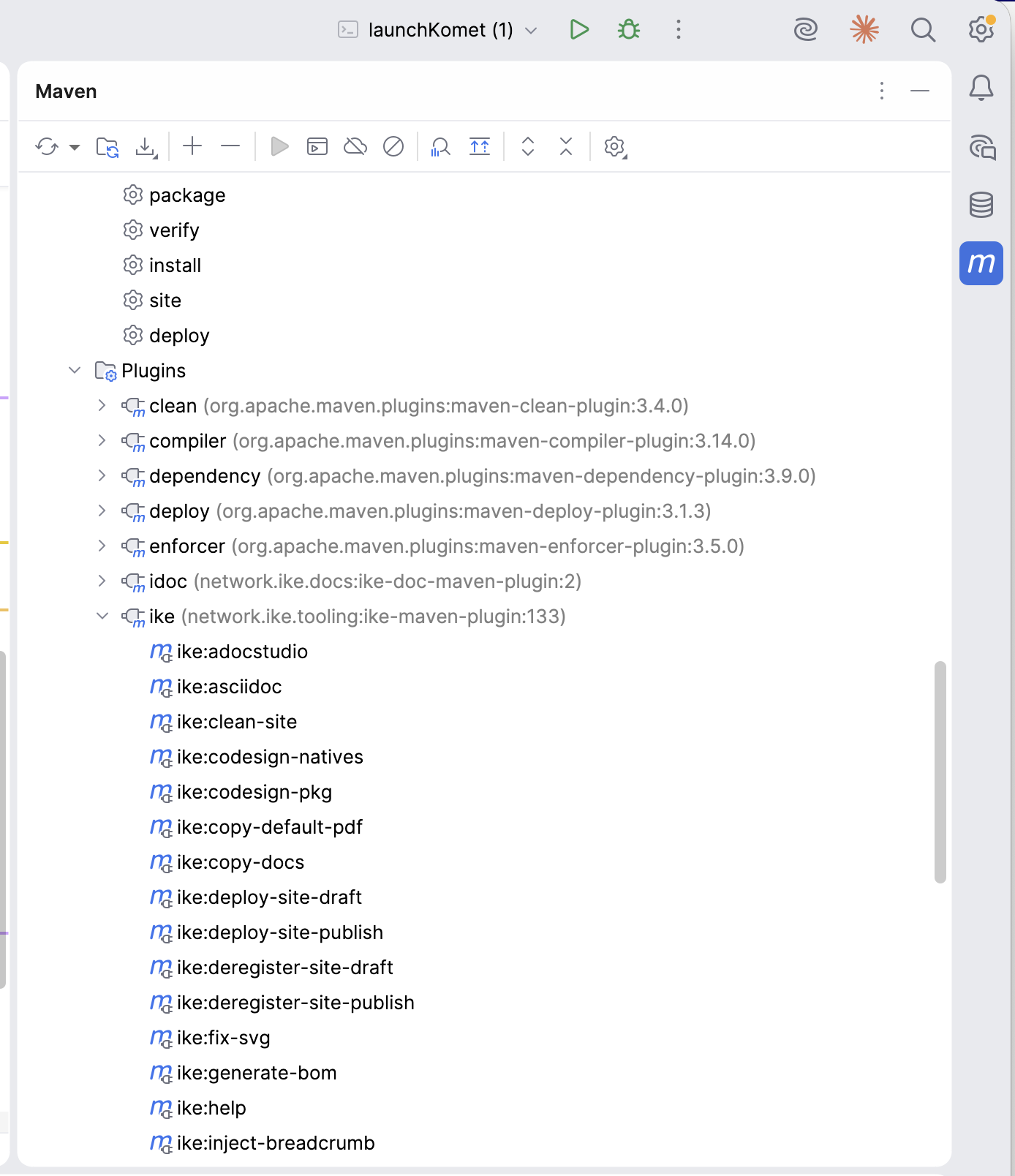
Expand the `ike (network.ike.tooling:ike-maven-plugin:…)` entry to see all `ike:*` goals:
Common interactions:
- **Run a read-only goal** (`ike:help`, `ike:env`) — **double-click** the goal in the tree.
- **Run a goal with parameters** (e.g. `ike:site-publish` with `-Dsite=removed` to uninstall) — **right-click** the goal → **Modify Run Configuration…** → fill `Properties` → **Run**.
- **Pin frequently-used invocations** — once a Run Configuration is saved, it appears in the toolbar dropdown for one-click access.
- **Discover goals** — `ike:help` prints the registry, but the Maven tool window has all goals visible by name without running anything.
For workspace-spanning operations, the same IntelliJ pattern applies to the `ws:*` plugin in `ike-platform` — see the [ws plugin Quick Start](https://ike.network/ike-platform/ike-workspace-maven-plugin/)[1].
## [#quick-start--command-line](#quick-start--command-line)Quick start — Command line
```
# Diagnose any in-flight or partial release (read-only)
mvn ike:release-status
# Preview a release (writes a markdown report; no on-disk changes)
mvn ike:release-draft
# Execute a release: tag, deploy to Nexus + komet.sh + gh-pages,
# bump to next SNAPSHOT
mvn ike:release-publish
# Re-deploy the site for the current release without re-releasing
mvn ike:site-publish
# Apply scaffold convention upgrades
mvn ike:scaffold-publish
```
## [#quick-reference](#quick-reference)Quick reference
| Goal | Phase | Purpose |
| --- | --- | --- |
| [release-{draft,publish}](#release-draft) | release | Single-repo release: tag, deploy to Nexus + komet.sh + GitHub Pages, bump |
| [verify-release-published](#verify-release-published) | release | Verify all post-release publication targets (6 read-only HTTP checks) |
| [site-{draft,publish}](#site) | site | Generate, deploy, and register the Maven site; `-Dsite=removed` uninstalls and deregisters |
| [ike:generate-bom](#generate-bom) | bom | Auto-generate a BOM POM from another module’s dependency management |
| [scaffold-{draft,publish,revert}](#scaffold) | scaffold | Apply the workspace scaffold manifest (gitignore, hooks, IDE settings) |
| [ike:inject-breadcrumb](#inject-breadcrumb) | site | Inject nav breadcrumbs into JaCoCo HTML reports |
| [ike:setup](#setup) | setup | Install VCS bridge git hooks to `~/.git-hooks/` |
| [ike:unpack-zip](#unpack-zip) | utility | Download + unpack a zip from a URL |
| [ike:rename](#rename) | utility | Rename a file (replaces `exec-maven-plugin` calls to `mv`) |
| [ike:codesign-natives](#codesign-natives) | native | Sign native libraries inside a jlink runtime image (macOS notarization) |
| [ike:codesign-pkg](#codesign-pkg) | native | Re-sign `.app` inside `.pkg` to add JVM entitlements |
| [ike:jpackage-props](#jpackage-props) | native | Compute build timestamp, platform, JPackage version properties |
| [ike:notarize](#notarize) | native | Sign + notarize macOS installer packages (.pkg, .dmg) |
| [ike:help](#help) | inspection | Discover available `ike:*` goals |
## [#release-goals](#release-goals)Release goals
### [#ike-release--draft-publish](#ike-release--draft-publish)ike:release-{draft,publish}
Full single-repo release in one command. The publish variant:
1. Creates a `release/` branch from current HEAD
2. Sets the release version (strips `-SNAPSHOT`)
3. Stamps `project.build.outputTimestamp` from the commit timestamp (reproducible builds)
4. Runs `mvn verify -B`
5. Tags `v`
6. Builds the site and deploys to scpexe internal site (`/srv/ike-site///`)
7. Updates the `latest` symlink to point at the new version (ike-issues#303)
8. Force-pushes the staged site to `/gh-pages` so it serves at `[https://ike.network//](https://ike.network//)[2]` via the org CNAME (ike-issues#312)
9. `clean deploy` to Nexus (signed via Bouncy Castle)
10. Pushes tag and main to origin
11. Creates a GitHub Release (uses milestone-based notes if a matching ` v` milestone exists)
12. Cleans up the snapshot/main site
13. Bumps to the next SNAPSHOT version
Failure recovery: re-run `ike:release-publish` and it picks up where the previous attempt left off (already-published phases are skipped).
If your reactor is the one that **builds** `ike-maven-plugin` (i.e., `ike-tooling` itself), see [Self-host bootstrap pattern](self-host-bootstrap.html)[3] for how the release flow’s site invocations sidestep the reactor cycle.
### [#ike-verify-release-published](#ike-verify-release-published)ike:verify-release-published
Verify that all six post-release publication targets are reachable for a given project + version. Read-only; exits non-zero on any check failure so it composes into shell pipelines and CI.
```
# Use pom defaults (artifactId + pom version with -SNAPSHOT stripped)
mvn ike:verify-release-published
# Explicit values (e.g., verifying from outside the released checkout)
mvn ike:verify-release-published -DprojectId=ike-tooling -Dversion=163
# Skip targets that aren't ready yet (e.g., immediately after tag push,
# before the org-site sync has had a chance to run)
mvn ike:verify-release-published -DskipOrgSite=true
```
Checks:
- Site (current): `[https://ike.network//](https://ike.network//)[4]`
- Site (versioned): `[https://ike.network///](https://ike.network///)[5]`
- Site (latest): `[https://ike.network//latest/](https://ike.network//latest/)[6]`
- Org-site landing: `[https://ike.network/](https://ike.network/)[7]`
- Nexus artifact: `[https://nexus.tinkar.org/…/ike-tooling-N.pom](https://nexus.tinkar.org/…/ike-tooling-N.pom)[8]`
- GitHub release: `[https://api.github.com/repos/IKE-Network//releases/tags/vN](https://api.github.com/repos/IKE-Network//releases/tags/vN)[9]`
ike-issues#374.
```
mvn ike:release-draft # preview
mvn ike:release-publish # execute
mvn ike:release-publish -DskipVerify=true # skip mvn verify (faster retry)
```
### [#ike-release-cascade-and-ike-cascade-export](#ike-release-cascade-and-ike-cascade-export)ike:release-cascade and ike:cascade-export
`ike:release-publish` releases one repo. The IKE **foundation** — `ike-tooling → ike-docs → ike-platform` — must release in order, because each consumes the artifacts of the ones above it. `ike:release-cascade` walks that order, releasing every foundation repo with unreleased changes; `ike:cascade-export` writes the cascade topology for a CI meta-runner. Both assemble the graph from each repo’s own `src/main/cascade/release-cascade.yaml`.
See [The IKE Release Cascade](release-cascade.html)[10] for the model, the manifest format, and how to test and run it.
## [#site-goals](#site-goals)Site goals
### [#ike-site--draft-publish](#ike-site--draft-publish)ike:site-{draft,publish}
Generate, deploy, and register the project’s Maven site in one converged goal (ike-issues#398). The publish variant builds the site, deploys it (version-prefixed directory + `latest` symlink + gh-pages push, matching what `release-publish` does for the site portion), and registers the project on the `IKE-Network/IKE-Network.github.io` org landing page (`[https://ike.network/](https://ike.network/)[7]`). Registration is part of the default flow — no separate goal.
Useful for re-deploying a site without re-releasing the artifact.
```
mvn ike:site-publish # deploy + register
mvn ike:site-publish -DupdateRegistration=false # deploy only, skip org landing page
mvn ike:site-publish -DupdateSite=false # registration only, no site deploy
mvn ike:site-publish -Dsite=removed # uninstall: remove the deployed
# site directory and deregister
```
The `-Dsite=removed` form replaces both the old `clean-site` (stale snapshot/checkpoint cleanup) and `deregister-site` goals — uninstall includes stale-dir cleanup and org-index removal. Use `ike:site-draft` to preview any of these without writing.
## [#bom-generation](#bom-generation)BOM generation
### [#ike-generate-bom](#ike-generate-bom)ike:generate-bom
Generate a standalone BOM POM from another module’s ``. The IKE BOM (`network.ike.platform:ike-bom`) is auto-generated this way from `ike-parent’s dependency management, ensuring the BOM never drifts from the parent’s version pins.
## [#scaffold-goals](#scaffold-goals)Scaffold goals
### [#ike-scaffold--draft-publish-revert](#ike-scaffold--draft-publish-revert)ike:scaffold-{draft,publish,revert}
Apply (or revert) the workspace scaffold — the conventional non-source files that every IKE workspace shares: `.gitignore`, git hooks under `~/.git-hooks/`, `.mvn/maven.config`, IDE settings (`.idea/`, `.vscode/`). The scaffold manifest is shipped as the `scaffold` classifier of `ike-build-standards`.
`scaffold-revert` undoes a previous `scaffold-publish` per the tier policy in the manifest (some files are tool-owned and revertible, others are tracked in version control and not touched on revert).
## [#site-and-setup-goals](#site-and-setup-goals)Site and setup goals
The AsciiDoc doc-rendering pipeline (`asciidoc`, `render-pdf`, `adocstudio`, `fix-svg`, `patch-docbook`, `prepare-renderer-output`, `copy-default-pdf`, `copy-docs`, `scan-logs`) moved to `ike-doc-maven-plugin` (`idoc:`) — see [the idoc plugin](https://ike.network/ike-docs/ike-doc-maven-plugin/)[11]. The two goals below stay in `ike-maven-plugin`: neither renders AsciiDoc.
### [#ike-inject-breadcrumb](#ike-inject-breadcrumb)ike:inject-breadcrumb
Inject navigation breadcrumbs and theme overrides into JaCoCo HTML reports so they fit visually with the rest of the Maven site.
### [#ike-setup](#ike-setup)ike:setup
Install the VCS bridge git hooks (pre-commit, post-commit, pre-push) to `~/.git-hooks/`. Run once per developer machine after first clone.
## [#native-packaging](#native-packaging)Native packaging
These are macOS-specific signing / notarization goals used by Komet desktop builds.
### [#ike-codesign-natives](#ike-codesign-natives)ike:codesign-natives
Sign native libraries (`.dylib`, `.jnilib`) inside a jlink runtime image so the resulting installer passes Apple notarization.
### [#ike-codesign-pkg](#ike-codesign-pkg)ike:codesign-pkg
Re-sign the `.app` bundle inside a jpackage-produced `.pkg` installer to add macOS entitlements required by the JVM.
### [#ike-jpackage-props](#ike-jpackage-props)ike:jpackage-props
Compute ~19 Maven project properties (build timestamp, platform, JPackage version) consumed by JReleaser’s jpackage descriptor.
### [#ike-notarize](#ike-notarize)ike:notarize
Sign and notarize macOS installer packages (`.pkg`, `.dmg`). Automates the Apple notarization workflow.
## [#utility-goals](#utility-goals)Utility goals
### [#ike-unpack-zip](#ike-unpack-zip)ike:unpack-zip
Download and unpack a zip archive from a URL. Uses `java.util.zip.ZipInputStream` directly — bypasses `unpack-dependencies` when the source isn’t a Maven artifact.
### [#ike-rename](#ike-rename)ike:rename
Rename a file within a directory. Replaces `exec-maven-plugin` calls to `mv` in the doc pipeline.
### [#ike-help](#ike-help)ike:help
Print a list of available `ike:*` goals, generated from the compile-time `IkeGoal` registry. Goal names cannot drift from the actual plugin because the registry is enforced at compile time.
## [#see-also](#see-also)See also
- [The IKE Release Cascade](release-cascade.html)[10] — how the three-repo foundation releases in order, and the goals that drive it.
- [Self-host bootstrap pattern](self-host-bootstrap.html)[3] — for reactors that build the plugin they want to bind.
- [ws:* plugin](https://ike.network/ike-platform/ike-workspace-maven-plugin/)[1] — workspace-spanning goals.
- [ike-tooling reactor home](https://ike.network/ike-tooling/)[12].
- [Source on GitHub](https://github.com/IKE-Network/ike-tooling)[13].
- [Issue tracker](https://github.com/IKE-Network/ike-issues)[14].